Vishal
Book Review | Siddhanta Live
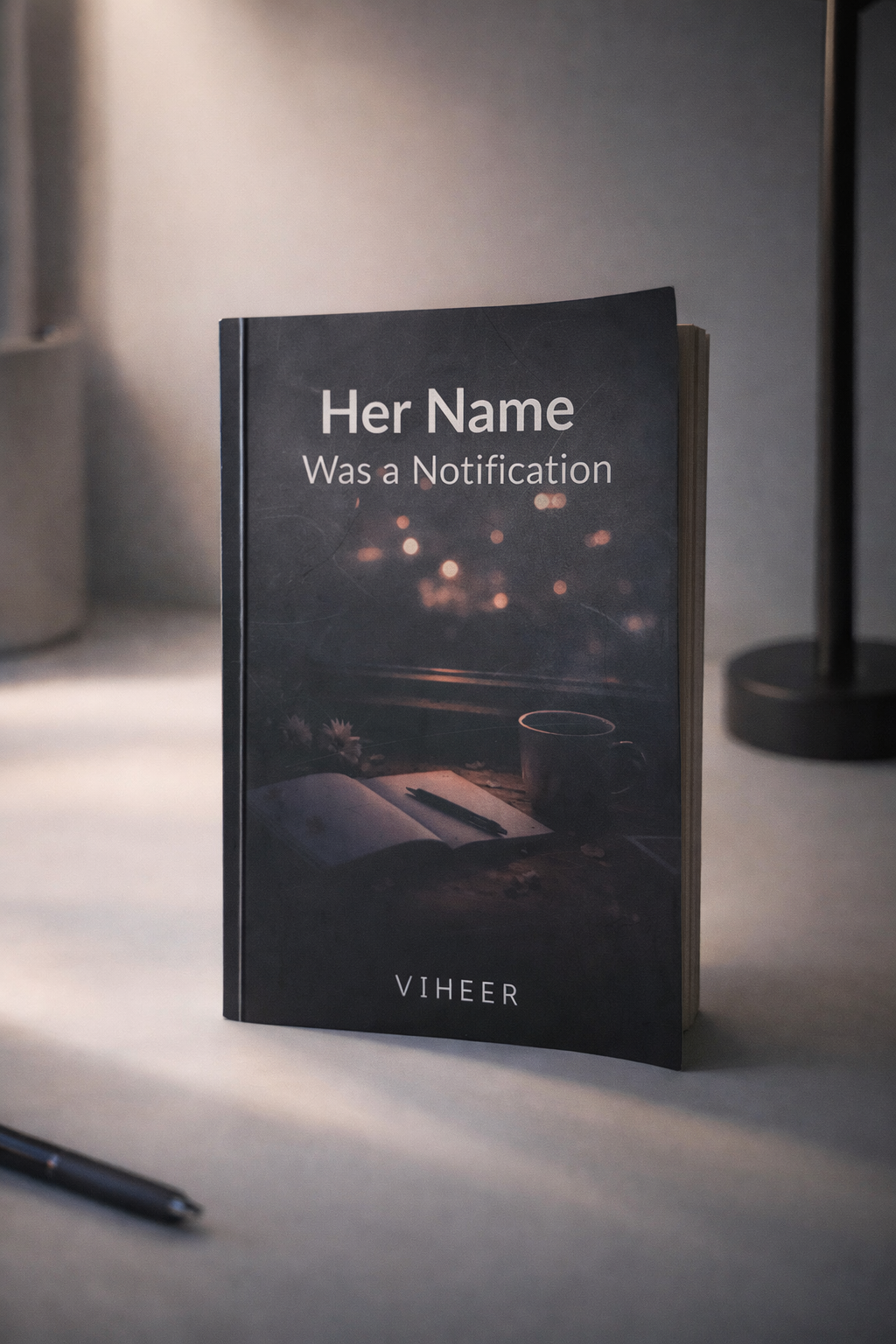
Title: Her Name Was a Notification
Author: Viheer
In an age where love arrives in pixels and departs in silence, Her Name Was a Notification stands as a haunting testimony to a generation that learned to feel deeply without ever touching. Viheer crafts not just a story, but an emotional landscape shaped entirely through screens, fragile, intense, addictive, and devastatingly real.
This is not a traditional romance. It is a chronicle of a bond born in the glow of a mobile screen, nurtured through late-night chats, hesitant confessions, and digital vulnerability. Two strangers meet not in a café or classroom, but in a space that has become the new emotional territory of modern humanity the notification bar.
What makes the novel remarkable is its brutal honesty. Viheer does not romanticize digital love; he exposes its paradox. Here, connection is instant yet intangible. Words become touch. Emojis become expressions. Voice notes carry more intimacy than physical presence ever could. And yet, the entire relationship exists in a realm where permanence is an illusion.
The story unfolds slowly, like a chat thread that deepens over time. At first, casual exchanges. Then curiosity. Then comfort. Then emotional dependency. The author captures this progression with astonishing precision. Anyone who has ever waited for a “typing…” indicator or felt their heartbeat rise at a familiar name lighting up their phone will see themselves reflected painfully in these pages.
But the novel’s true strength lies in its silence, the fading of connection. There is no dramatic betrayal, no confrontation, no closure. Just absence. A name that stops appearing. A chat that goes cold. A space once filled with warmth that now echoes with unanswered messages. Viheer shows that the cruelest endings in the digital world are not loud; they are invisible.
This quiet disappearance becomes the emotional core of the book. It explores a new form of grief — mourning someone who was never physically present yet emotionally central. A love that leaves no photographs, no memories of shared places, no tangible proof of existence only screenshots in the mind and conversations that replay in solitude.
The writing is poetic, layered, and introspective. The narrative flows like fragments of thought mixed with emotional realism. Rather than a conventional structure, the novel feels like lived experience — raw, personal, and deeply reflective. Vi-Heer uses language like a mirror to modern loneliness, where people speak endlessly yet remain unheard, connected to thousands yet emotionally starving.
The title itself is one of the most powerful metaphors in recent contemporary writing. A person reduced to a notification — something that appears suddenly, controls attention, creates emotional highs, and disappears without warning. It symbolizes how technology has reshaped human attachment, making presence measurable in pings rather than proximity.
What elevates the book beyond romance is its philosophical undercurrent. It questions whether digital intimacy is lesser than physical love or perhaps even more dangerous because it enters directly into the mind and emotions without the grounding reality of the physical world. The novel subtly argues that virtual love is not fake; it is incomplete. And incompleteness can hurt more than rejection.
Vi-Heer also captures the psychology of modern emotional addiction. The anticipation, the dependency, the illusion of closeness, the comfort of anonymity, and the slow erosion of emotional stability when that connection breaks. The novel becomes a study of how technology amplifies feelings while weakening emotional resilience.
This book will resonate especially with the youth a generation raised on chats, reels, DMs, and late-night digital companionship. But it is equally a warning. It shows how easily emotional lives can be built on unstable foundations. When love exists only in data, it can vanish without a trace leaving the heart with no evidence to hold onto.
The ending lingers like an unread message. There is no closure because digital relationships rarely offer one. And that is precisely why the novel feels so real. It doesn’t conclude it dissolves. Just like most modern connections.
Her Name Was a Notification is not just a love story. It is a mirror to contemporary emotional culture. It captures the beauty and tragedy of connection in the digital era with rare sensitivity and authenticity. Viheer has written a novel that feels like memory, like longing, like silence like a conversation that changed a life and then disappeared from the screen forever.
For Siddhanta Live, this book represents an important cultural document. It speaks of a new kind of heartbreak that literature has only begun to explore where love is real, loss is real, but the relationship itself leaves no physical footprint.
A deeply moving, painfully relatable, and philosophically rich work that defines romance for the notification generation.
Buy Here: