 Vishal
With a reputation for exposing buried truths, filmmaker Vivek Agnihotri finds himself at the center of yet another storm.
His films, often rooted in historical truths that many would rather forget, have repeatedly sparked debates, legal battles, and political backlash.
His latest venture, The Bengal Files, is no exception.
As the third installment in his Files trilogy following The Tashkent Files (2019) and The Kashmir Files (2022)-this film promises to expose yet another dark chapter of India’s history: the 1946 Great Calcutta Killings and the systemic violence against Hindus in Bengal.
But before the film even hits theaters on September 5, 2025, Agnihotri and his team find themselves entangled in a web of legal challenges.
Multiple FIRs have been filed against them by members of West Bengal’s ruling Trinamool Congress (TMC), accusing the film of inciting communal disharmony. The question is: Why is a political party so desperate to stop a movie?
The Suppression Game: FIRs, Fear, and the Fight for Truth
In a candid and emotionally charged video message from the United States—where he is currently engaged in the global promotion of The Bengal Files-director Vivek Agnihotri laid bare the relentless political backlash his film is facing.
With visible concern but unwavering resolve, he revealed that a barrage of FIRs (First Information Reports) has been systematically filed against him and his team by members of the ruling Trinamool Congress party in West Bengal.
“The ruling party of West Bengal and their members have been filing so many FIRs against us in different cities, in different police stations, in different jurisdictions,” he said. “This is not random—this is their strategy. A well-thought-out plan to trap us in endless legal battles, to drain our resources, consume our time, and prevent us from focusing on the most important task: bringing this film to the people of India.”
Important & Urgent:
Multiple FIRs have been filed against me by the West Bengal govt for making #TheBengalFiles.
The Hon’ble High Court has stayed them.
Why do they want to silence us? Why are they so scared of the truth?
I will not be silenced.
Pl Watch & Share.… pic.twitter.com/ksQpMA7476
— Vivek Ranjan Agnihotri (@vivekagnihotri) August 5, 2025
This coordinated legal assault isn’t just about inconvenience—it’s an alarming example of state machinery being used to silence a narrative that challenges the ruling establishment. FIRs—typically filed to address serious criminal complaints—are now being wielded as political weapons to stifle dissent and creativity. In this case, they’re being used to send a chilling message to any artist who dares to uncover inconvenient truths.
Yet, despite these heavy-handed tactics, there is a ray of hope. The Calcutta High Court stepped in to uphold the constitutional value of free expression, granting an interim stay on these FIRs. The court recognized the potential abuse of the legal system in this matter and temporarily shielded the filmmaker from further harassment.
But the battle is far from over.
Even as the High Court proceedings were underway—even as the ink on the stay order was still drying—new FIRs were being filed in different cities. This was no coincidence. It was a blatant demonstration of political intent: to overwhelm Agnihotri and his team with sheer legal volume, knowing full well that every new complaint brings with it hours of legal paperwork, court hearings, and emotional strain.
This relentless campaign reveals something far more disturbing than just political rivalry or artistic disagreement—it reveals a deep-rooted fear.
Fear of truth.
Fear of exposure.
Fear that the historical narrative being challenged in The Bengal Files might spark a reckoning the ruling class would rather avoid.
By turning law enforcement into a tool for intimidation, and by making the act of filmmaking a battleground, the establishment is not just attacking a director—it’s undermining the very foundation of democracy. Because when truth-tellers are hounded with legal threats, it’s not just their voice that’s being silenced—it’s the voice of every Indian who deserves to know the truth.
Agnihotri’s courage lies not just in making the film, but in refusing to be bullied into submission. As he continues his fight from across the ocean, one thing becomes increasingly clear: The Bengal Files is more than a film now—it is a movement against fear, censorship, and the suppression of truth.
Why Are They Afraid of ‘The Bengal Files’?
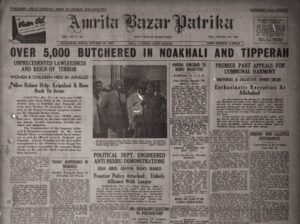
The Bengal Files doesn’t just tell a story—it resurrects a buried history that challenges the very foundations of political narratives maintained for decades. At its core, the film delves into the horrific events of the 1946 Calcutta Killings—a brutal and tragic episode that unfolded in the lead-up to India’s Partition. In this chilling massacre, thousands of innocent Hindus were mercilessly slaughtered in a wave of communal violence that turned the streets of Calcutta into a cauldron of blood and chaos. These events, though well-documented by independent historians, have remained conspicuously absent from mainstream discourse, school textbooks, and public memory until now.
But the film does not stop at history. It dares to connect the past with the present. The Bengal Files reportedly also explores recent flashpoints of violence, such as the Murshidabad riots of April 2025, which erupted over contentious amendments to Waqf laws that regulate Muslim charitable properties. The region witnessed outbreaks of tension, administrative paralysis, and reported attacks on members of the Hindu community—yet these events barely made national headlines.
Is Bengal becoming the new Kashmir?
1946 was a warning. Murshidabad is a reminder.Same tactics. Same silence. Same destruction.#BrutallyHonest
Watch Now: https://t.co/e4nRBnxuCE pic.twitter.com/sSbyy2uKvq
— Vivek Ranjan Agnihotri (@vivekagnihotri) May 18, 2025
Director Vivek Agnihotri, known for his unapologetic truth-telling, poses a hauntingly direct question:
“Why do they want to suppress our voice? Why don’t they want this dark chapter of Indian history to come out?”
And the answer, to many, is both obvious and alarming.
Those in power are afraid of the truth.
Because truth has consequences.
>Because truth threatens power built on selective memory.
>Because truth, when seen and acknowledged, cannot be unseen.
Much like Agnihotri’s earlier film The Kashmir Files—which stirred the nation by bringing to light the genocide and exodus of the Kashmiri Pandits—The Bengal Files threatens to unearth an even wider pattern of historical neglect and political whitewashing.
For the Trinamool Congress (TMC), which has long positioned itself as a bastion of secularism, this film is a direct challenge to its projected image. By shining a light on communal violence from the past and linking it to current events in Bengal, The Bengal Files forces a conversation the ruling establishment seems desperate to avoid.
If even half of what the film seeks to reveal gains traction, it could undermine the TMC’s cultivated narrative of communal harmony and inclusive governance. It could force uncomfortable questions about administrative failures, biased policies, and the politicization of religion under the guise of secularism.
This isn’t just about one film. This is about a battle for narrative control.
Agnihotri’s film is being seen by critics of the establishment as a bold act of historical correction, and by its opponents as a dangerous disruption to carefully managed optics.
But perhaps what frightens the political class most is that The Bengal Files—much like The Kashmir Files—has the potential to awaken public consciousness, particularly among the youth who have never been told this side of India’s story.
In an age where information is power, and storytelling can shape political futures, The Bengal Files is a seismic threat—not because it lies, but because it insists on telling the truth.
And that is what makes it so dangerous to those who thrive in darkness.
Read Also:-
A Pattern of Censorship
The recent controversy surrounding The Bengal Files is not an isolated event—it is part of a disturbing and increasingly visible pattern of censorship that raises serious concerns about the state of artistic freedom and free speech in India. Time and again, films that challenge dominant political ideologies, expose inconvenient truths, or seek to present alternate perspectives on history have faced unprecedented pushback from state machinery, particularly when the ruling party’s narrative is under threat.
This is not the first instance where West Bengal’s Trinamool Congress (TMC)-led government, under Chief Minister Mamata Banerjee, has attempted to block a film from reaching the public. In 2023, the state government imposed a blanket ban on the film The Kerala Story, alleging that its content might disturb communal harmony.
The film, which depicted the radicalization and trafficking of young women in Kerala, became the center of national debate. Critics accused the government of suppressing freedom of expression under the guise of maintaining peace, while supporters of the film called the ban a blatant act of political censorship.
The case eventually reached the Supreme Court of India, which overturned the state-imposed ban in a landmark ruling. The Court firmly reminded the nation that “public intolerance cannot dictate artistic expression.” It was a powerful affirmation of creative freedom, and a slap on the wrist for those who believe that disagreeable ideas should be silenced rather than debated.
Yet, just two years later, we find ourselves witnessing a repeat of the same suppression playbook—this time with The Bengal Files.
While the circumstances differ, the intention appears eerily similar: to prevent the dissemination of a politically inconvenient narrative.
Instead of outright banning the film (which could invite judicial intervention), the TMC seems to be taking a more insidious approach burying the film under an avalanche of FIRs and legal harassment, filed across multiple districts to entrap the creators in a web of litigation.
This strategy of legal warfare is clearly designed to derail the film’s promotion, limit its reach, and intimidate its creators. And the timing of this coordinated effort is no coincidence.
With the 2026 West Bengal Assembly elections on the horizon, the ruling party is visibly anxious about any narrative that could dent its image or provoke critical public discourse particularly on sensitive issues like communal violence, historical injustice, and administrative bias.
The pattern is clear: whenever a film seeks to raise uncomfortable questions about sectarian violence, state failure, or political opportunism, it becomes a target.
Instead of engaging with the message, the establishment seeks to silence the messenger.
But censorship—whether direct or disguised is a dangerous game. In trying to control the narrative, the ruling powers often amplify the very voices they seek to suppress.
If history has taught us anything, it is this: truth has a way of breaking through, no matter how many legal walls are built to contain it.
By targeting The Bengal Files, the TMC is not just censoring a film it is participating in a larger, more ominous trend of intellectual intolerance, where state power is used not to protect democracy, but to stifle dissent and control the cultural conversation.
Agnihotri’s Challenge: Truth Will Prevail
Despite facing a relentless onslaught of legal intimidation, bureaucratic hurdles, and political hostility, Vivek Agnihotri stands undeterred.
Far from backing down, the filmmaker has responded to the attacks with greater resolve, transforming adversity into an opportunity to reaffirm his commitment to truth and justice through cinema.
In a recent statement, Agnihotri shared a revealing glimpse into the behind-the-scenes struggles his team endured while making The Bengal Files.
“We were not allowed to shoot in Bengal. We had to film the entire movie in Mumbai,” he explained, highlighting the extent to which local authorities allegedly obstructed the film’s production.
This refusal of permission—issued by a state that should ideally promote artistic expression—underscores the depth of institutional resistance he has faced.
Shooting in Mumbai, far from the soil where the events being depicted actually unfolded, was no mere inconvenience.
It was a forced compromise, emblematic of a system that seeks to erase uncomfortable histories rather than confront them. Yet, Agnihotri and his team pressed on, driven by their belief that some stories demand to be told, no matter the cost.
What makes Agnihotri’s stance particularly striking is his refusal to play the victim. Instead, he has turned the tables with an unwavering message to the political establishment:
“Challenge accepted.”
This phrase is not just a defiant rebuttal it’s a declaration of war against censorship, cowardice, and political manipulation. And he is backing it up with action.
In a bold and symbolic move, Agnihotri announced that the trailer for The Bengal Files will be released first in West Bengal itself, the very state whose government has worked so hard to suppress the film’s existence.
This isn’t just a strategic rollout it’s a statement that the truth cannot be silenced, not by FIRs, not by political threats, and certainly not by fear.
By choosing West Bengal as the launching ground, Agnihotri is challenging the status quo on its home turf, daring those in power to confront the truth rather than bury it. It’s an act of cinematic resistance—one that carries weight far beyond marketing or media attention.
It asserts that art has the power to speak where politics stays silent, and that no government, however powerful, can suppress the will of a filmmaker who is speaking for the voiceless.
Agnihotri’s determination is particularly focused on India’s youth, a generation that has often inherited a sanitized, filtered version of history. He wants The Bengal Files to be more than a film—to serve as a wake-up call, an invitation to question, to learn, and to look beyond political narratives and media silence.
His faith lies in the people, especially the young minds of the nation who still seek the truth. “We want this film to reach every Indian,” he said, “especially the youth who have the right to know what really happened.”
In this battle between narrative control and artistic courage, Agnihotri has made it clear that he will not retreat. For him, The Bengal Files is not just a film—it’s a mission. And its core message resonates louder than ever:
The truth will prevail.
The Fight for Free Speech and Historical Justice
Vivek Agnihotri’s body of work transcends the boundaries of traditional cinema. His films are not just stories told on screen—they are catalysts of national introspection, unearthing chapters of history long buried under political convenience and collective silence. With The Tashkent Files, he questioned the murky circumstances surrounding the death of India’s second Prime Minister, Lal Bahadur Shastri. With The Kashmir Files, he forced the nation to look directly at the pain and trauma of the Kashmiri Pandit exodus. And now, with The Bengal Files, he has turned his lens toward yet another painful and largely ignored truth: the 1946 Calcutta Killings and the long-standing pattern of Hindu persecution in Bengal.
These are not easy stories to tell—and they are certainly not stories the political establishment wants the public to hear. The fierce backlash against The Bengal Files, especially from the ruling Trinamool Congress in West Bengal, is not just about one film. It is a battle over who gets to control history—and who gets to silence those who challenge the status quo.
When a government responds to a film with FIRs, shoot bans, and coordinated legal harassment, it says more about the insecurity of the establishment than the content of the film.
If there truly was nothing to hide, there would be no fear. But the fear is real—and so is the significance of this film.
The fact that The Bengal Files has already stirred such widespread resistance before its release is proof that it touches a raw nerve. It poses questions that demand answers—and answers that could disrupt carefully crafted political narratives.
This is not just about free speech in the artistic sense it is about the fundamental right of citizens to access their own history without filters, censorship, or propaganda.
When historical truths are manipulated or erased, society loses its moral compass. Agnihotri’s mission is to restore that compass, no matter how much resistance he faces along the way.
As the legal battles continue to unfold in the courts and public forums, one thing becomes abundantly clear:
The truth cannot be silenced.
The judiciary has already offered some hope, with the Calcutta High Court issuing a stay on the initial FIRs. But the real test lies in whether society has the courage to confront its uncomfortable truths, even when they come wrapped in controversy.
When The Bengal Files releases on September 5, 2025, it will be more than just a movie premiere—it will mark the arrival of a reckoning. A reckoning with history.
A reckoning with silence.
A reckoning with the systemic suppression of narratives that don’t align with political agendas.
And the biggest question of all looms large:
Will the people of Bengal—and of India—finally hear the untold story?
Or will political forces once again succeed in burying it beneath layers of censorship, fear, and false secularism?
The answer doesn’t lie in courtrooms or press releases. It lies in the courage of ordinary citizens to listen, to question, and to demand the full picture of their own past. Only then can justice—historical and moral—truly begin.
In the end, The Bengal Files may not be just another film.
It may be the spark that lights the fire of truth—and the beginning of the end for a long era of silence.
Read Also:-





Awesome post.