Vishal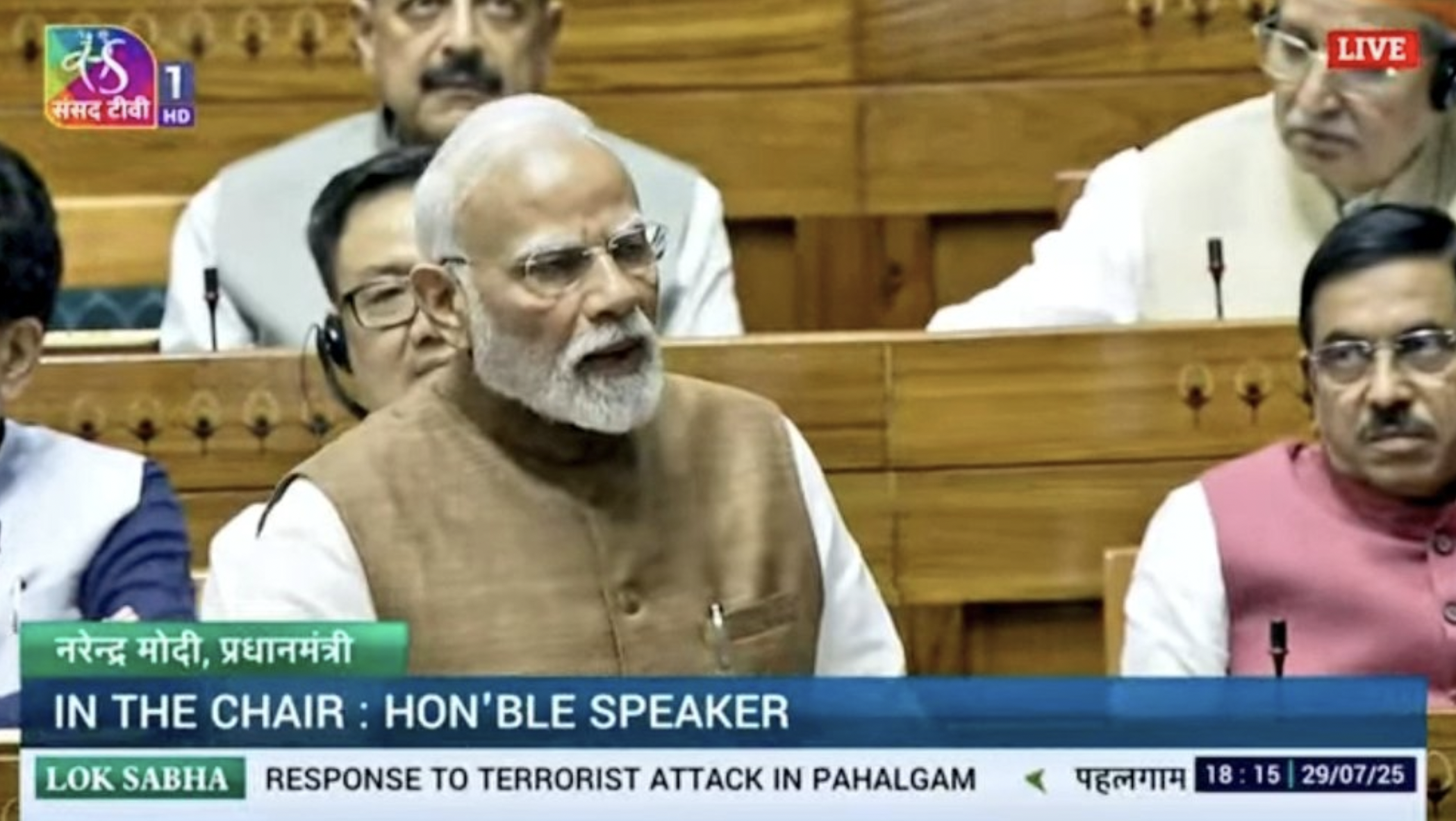
New Delhi, July 30, 2025 — Prime Minister Narendra Modi delivered a powerful and wide-ranging address in the Lok Sabha, detailing the success of Operation Sindoor, India’s response to the Pahalgam terror attack.
His speech not only dismantled misinformation around the operation, but also took a sharp dig at the Opposition and questioned the historical decisions made by India’s first Prime Minister, Jawaharlal Nehru.
From busting Pakistan’s nuclear bluff to defending India’s sovereign right to retaliate against terror, PM Modi’s remarks are now being seen as a defining moment in India’s national security narrative.
Here’s a summary of the key highlights from PM Modi’s speech that reflect his government’s assertive defence strategy and evolving foreign policy:
1. Exposing the Nuclear Bluff and Asserting India’s Right to Strike
Prime Minister Narendra Modi made a powerful statement in the Lok Sabha, asserting that Operation Sindoor had effectively shattered Pakistan’s long-standing nuclear threat narrative.
He emphasized that for decades, Pakistan had used the threat of its nuclear arsenal as a shield to protect its terror infrastructure. However, by launching deep and precise strikes within Pakistani territory, India has firmly rejected the idea that it can be intimidated by nuclear blackmail.
PM Modi stated unequivocally, “India will no longer bow down to nuclear blackmail.” This bold declaration reflects a significant strategic shift in India’s defence posture from restraint to assertive deterrence.
It signals to both domestic and international observers that India is willing and capable of neutralizing cross-border threats without being constrained by Pakistan’s nuclear posturing.
In a landmark move, Indian forces targeted and decimated terror strongholds in Bahawalpur and Muridke areas that had remained untouched even during previous full-scale wars like those of 1965 and 1971.
These locations are known to be long-time safe havens for terrorist organizations operating under Pakistan’s tacit support.
By striking these high-value targets, India not only eliminated operational bases of terrorism but also sent a strong geopolitical message that acts of terror will no longer go unanswered.
The operation, according to PM Modi, was executed with exceptional speed and precision. Within just 22 minutes of launching the offensive, Indian forces had avenged the brutal April 22 Pahalgam terror attack.
The strikes were carried out with such surgical accuracy that they left the Pakistani military establishment and terror outfits in a state of disarray.
The element of surprise, combined with India’s advanced weaponry and indigenous defence technology, ensured minimal collateral damage while maximizing strategic impact.
Moreover, PM Modi highlighted how this daring act has shifted global perceptions about India’s military capability and resolve. The world watched as India, a responsible nuclear power, acted decisively without escalating into broader conflict.
By calling Pakistan’s bluff and defending national security with confidence, India has redrawn the red lines of engagement in South Asia.
This operation serves as a clear indication that India is now prepared to take bold, calculated actions in response to terrorism, irrespective of the nuclear rhetoric from its adversaries.
It marks the beginning of a new strategic doctrine one rooted in strength, clarity, and self-reliance.
2. “No World Leader Told Us to Stop” – Countering Trump’s Claims
In a firm and unambiguous rebuttal to former US President Donald Trump’s repeated claims of mediating a ceasefire between India and Pakistan, Prime Minister Narendra Modi used his address in the Lok Sabha to set the record straight.
Modi categorically stated that no head of state, international leader, or global organization asked India to halt Operation Sindoor. This clear declaration dispelled any lingering confusion and reaffirmed India’s autonomy in making strategic military decisions.
PM Modi recounted a critical moment from May 9, when US Vice President JD Vance attempted to contact him multiple times amidst escalating tensions.
At that point, India had already launched the initial phase of Operation Sindoor in retaliation to the gruesome Pahalgam terror attack. Due to ongoing high-level meetings with senior military commanders and national security advisors, Modi was unable to take the call immediately.
However, when he eventually spoke to the Vice President, Vance relayed urgent intelligence suggesting Pakistan was planning a large-scale retaliatory strike.
PM Modi’s response was resolute and unequivocal: “If Pakistan has intentions to attack, it will pay a heavy price. We will not respond with bullets we will respond with cannonballs.”
This message was not just for the United States but for the global community it signaled that India was no longer playing defence in the face of terrorism and cross-border aggression.
Reinforcing this message of strength, the Prime Minister shared a significant operational detail: during Pakistan’s attempted counterattack, India’s robust and modernized air defence systems neutralized approximately 1,000 missiles and armed drones mid-air.
These advanced systems, many of which are made in India, demonstrated their effectiveness under real-world combat scenarios, saving countless civilian and military lives. It marked a milestone in India’s technological self-reliance and military preparedness.
PM Modi emphasized that India’s military operations were carried out with complete sovereignty and strategic clarity, without succumbing to any diplomatic pressure or foreign influence.
Unlike in the past, when global powers often intervened in subcontinental conflicts, the world this time watched India take decisive action against terror with maturity and discipline.
Furthermore, the Prime Minister subtly highlighted a growing international recognition of India’s status as a responsible global power. While Pakistan expected global sympathy by invoking the nuclear card, only three out of 193 United Nations member countries expressed any support for Islamabad. The rest either backed India or remained neutral, recognizing New Delhi’s right to defend itself against state-sponsored terrorism.
ऑपरेशन सिंदूर को लेकर विजयोत्सव का मतलब है- हमारी सेनाओं के शौर्य और सामर्थ्य की विजय गाथा का उत्सव! pic.twitter.com/cSq8u2yJYM
— Narendra Modi (@narendramodi) July 30, 2025
In essence, PM Modi’s statement not only debunked Trump’s claim but also underscored a new era in Indian foreign policy—one where India dictates its own terms, acts without hesitation, and stands firm in the face of provocation. It was a moment that reflected the maturity of India’s leadership and the confidence of a nation determined to safeguard its people and sovereignty at all costs.
3. Rectifying Historical Mistakes: Nehru and the Indus Waters Treaty
Prime Minister Narendra Modi did not mince words when addressing what he described as a monumental diplomatic misstep in India’s post-independence history the signing of the Indus Waters Treaty (IWT).
In his powerful address, Modi labelled the treaty as “one of Jawaharlal Nehru’s biggest blunders,” accusing India’s first Prime Minister of surrendering a vital natural resource to Pakistan under the guise of goodwill and appeasement.
The Indus Waters Treaty, signed in 1960 and brokered by the World Bank, granted over 80% of the waters from the Indus river system including the Indus, Jhelum, and Chenab rivers to Pakistan, leaving India with only the remaining 20% (primarily the Ravi, Beas, and Sutlej rivers).
PM Modi highlighted how this lopsided agreement has handicapped India’s agricultural and strategic water interests for decades, especially in the border states of Jammu & Kashmir, Punjab, and Himachal Pradesh.
“This was not diplomacy it was a surrender,” Modi declared, pointing out that water, the most critical resource for any civilization, was handed over to an adversary that has consistently engaged in cross-border terrorism and hybrid warfare against India. He emphasized that the time has come to stop rewarding aggression with accommodation. “Blood and water cannot flow together,” he asserted, reinforcing the idea that India’s water resources cannot be shared with a nation that supports terror against Indian citizens.
In the aftermath of the April 22 Pahalgam terror attack, the government took a decisive and long-overdue step by placing the Indus Waters Treaty in abeyance.
This move effectively suspends India’s cooperation with the treaty and allows the government to revisit the water-sharing terms based on contemporary realities, national interest, and security concerns. The decision has been widely praised by strategic analysts, military veterans, and nationalist thinkers, who have long argued that the treaty unfairly benefits Pakistan while restricting India’s developmental rights.
PM Modi further emphasized that this is not just about water it’s about reclaiming India’s dignity, sovereignty, and control over its own natural resources. He framed the abeyance of the treaty as part of a broader effort to correct historical wrongs that have hindered India’s growth and emboldened its enemies.
The message was clear: India will no longer be bound by outdated agreements made under political pressure or misplaced idealism. It will act in accordance with its national interest, security needs, and the aspirations of its people. Revisiting the Indus Waters Treaty marks not only a diplomatic pivot but also a powerful assertion of India’s civilizational rights and strategic sovereignty.
4. Lashing Out at the Opposition
In one of the most hard-hitting segments of his address, Prime Minister Narendra Modi launched a fierce and uncompromising attack on the Congress party and its allies, accusing them of placing political gains above national security and the morale of the armed forces. He condemned the opposition’s behavior during and after Operation Sindoor, saying their skepticism and constant demand for “proof” echoed a disturbing pattern of undermining India’s security forces.
PM Modi reminded the House and the nation that this was not the first time the Congress party had cast doubts on the bravery of Indian soldiers.
He drew a direct parallel with the aftermath of the 2016 surgical strikes and the 2019 Balakot airstrikes, where Congress leaders questioned the authenticity of India’s military operations and asked for video evidence, despite detailed briefings by the Ministry of Defence. “History is repeating itself,” he said, “but this time the people of India are watching more closely, and they will not forgive such betrayal.”
हम गोली का जवाब गोले से देंगे! pic.twitter.com/0XYwJzyu2F
— Narendra Modi (@narendramodi) July 30, 2025
He further criticized the Congress for stifling its few moderate and knowledgeable voices.
Modi specifically named senior leaders like Shashi Tharoor and Manish Tewari, suggesting that they were silenced or sidelined by their party leadership for speaking in more nuanced or patriotic tones.
“Why are your senior, well-read leaders not allowed to speak in Parliament? Why do you suppress those who might dare to appreciate the courage of our armed forces?” Modi asked, pointing to a deep internal crisis within the opposition.
The Prime Minister didn’t hold back in accusing opposition leaders of echoing narratives that align more with Pakistan’s propaganda machinery than with India’s national interest.
“Even when our brave soldiers were punishing terrorists inside enemy territory, some leaders here were shedding tears for the terrorists,” he said, striking a chord of deep emotional resonance with both lawmakers and the public.
He implied that such statements not only hurt the morale of the armed forces but also give comfort and validation to hostile foreign powers.
PM Modi warned that politicizing military operations for short-term electoral gain is not just irresponsible, but dangerous.
He underscored that national security is above party lines and must never be treated as a tool for partisan posturing.
“This is not just an insult to the government it is an insult to every soldier who risks his life for this country,” he thundered.
He concluded the segment with a stark message: while India is changing boldly, confidently, and decisively some political parties remain trapped in a mindset of appeasement, cynicism, and moral ambiguity.
“The people of India can see the difference between those who stand with Bharat and those who seek to weaken it from within,” he said, making it clear that the upcoming elections would not just be a political contest but a referendum on national loyalty and vision.
5. Showcasing India’s Defence Transformation and ‘Aatmanirbhar Bharat’
Prime Minister Narendra Modi used the opportunity to highlight the sweeping transformation in India’s defence preparedness and technological self-reliance under his leadership, framing it as the foundation for the success of operations like Sindoor.
He credited a decade of sustained reforms, strategic investments, and visionary planning for enabling India to respond swiftly, surgically, and decisively to external threats.
Modi emphasized that Operation Sindoor was not a one-off achievement, but the culmination of years of strengthening India’s indigenous defence capabilities under the Aatmanirbhar Bharat (self-reliant India) initiative.
He pointed out that the operation was executed using homegrown military technology from state-of-the-art drones and unmanned aerial vehicles (UAVs) to advanced missile systems, smart bombs, and precision-guided munitions. “These were not borrowed weapons or outsourced operations,” he said proudly. “These were Indian weapons, powered by Indian intelligence, and executed by Indian soldiers.”
पहलगाम हमले पर कांग्रेस ने पाकिस्तान को क्लीन चिट दे दी है। ये पहली बार नहीं है, जब देश में आतंकी घटनाओं को लेकर उसने ऐसा रवैया दिखाया है। pic.twitter.com/iZFk4jCHLF
— Narendra Modi (@narendramodi) July 30, 2025
Citing hard data, the Prime Minister declared, “Defence exports have grown 30 times in the last 10 years,” turning India from a traditional importer into an emerging global exporter of military equipment.
Indian-made helicopters, radar systems, and missile components are now being exported to friendly nations across Asia, Africa, and Latin America a clear signal that India is rising as a credible defence manufacturing hub.
Modi also stressed the importance of long-overdue structural reforms in the defence sector.
He highlighted the appointment of the Chief of Defence Staff (CDS) a landmark decision that streamlined coordination between the Army, Navy, and Air Force.
The creation of theatre commands and promotion of jointness and interoperability among the forces has significantly improved India’s ability to mount swift and integrated responses in modern, hybrid warfare scenarios.
Furthermore, the Prime Minister pointed to increased private sector participation and the growing role of Indian start-ups in areas such as defence AI, robotics, cybersecurity, and aerospace.
Defence corridors in Uttar Pradesh and Tamil Nadu, along with innovation challenges and military-industrial collaborations, have unleashed a wave of indigenous research and production, replacing imports with domestically built alternatives.
He also praised the role of the DRDO, HAL, and ISRO, whose synergy with private companies has led to the creation of world-class defence products like the Tejas fighter jet, Akash missile system, Pinaka rocket launchers, and anti-drone technology that played a crucial role during Pakistan’s attempted retaliation in the Sindoor aftermath.
PM Modi framed this transformation not just as a technological or strategic leap but as a matter of national pride, sovereignty, and global positioning. “For decades, India was dependent on others to protect its borders. Today, India not only protects itself but helps others protect theirs. This is the new India fearless, capable, and self-reliant,” he said, drawing applause from the House.
“India’s defence forces are no longer reactive they are proactive, modern, and ready for any challenge.”
Aatmanirbhar Bharat is not a slogan; it is India’s new strategic doctrine.
A New Doctrine in India’s Fight Against Terror
PM Modi’s speech marks a strategic shift in India’s approach to national security from reactive diplomacy to proactive deterrence. Operation Sindoor, as outlined by the PM, is not just a military operation, but a symbolic assertion of India’s refusal to tolerate cross-border terrorism and historical appeasement.
With Operation Sindoor, India has set a new precedent: it will strike hard, strike first, and strike deep to protect its sovereignty. And as PM Modi put it, “India is a land of Buddha, but peace comes only with power.”
Read Also:-
-
Blood on Our Soil, Cricket on the Screen – The Pahalgam Paradox
-
India Prepares for External Threats with Nationwide Mock Drills Starting May 7
-
PM Modi Attends G7 Summit in Canada After Historic Cyprus Visit: Strengthening Global Ties
-
India and Pakistan Agree to Full Ceasefire: US Mediates Historic Truce