Vishal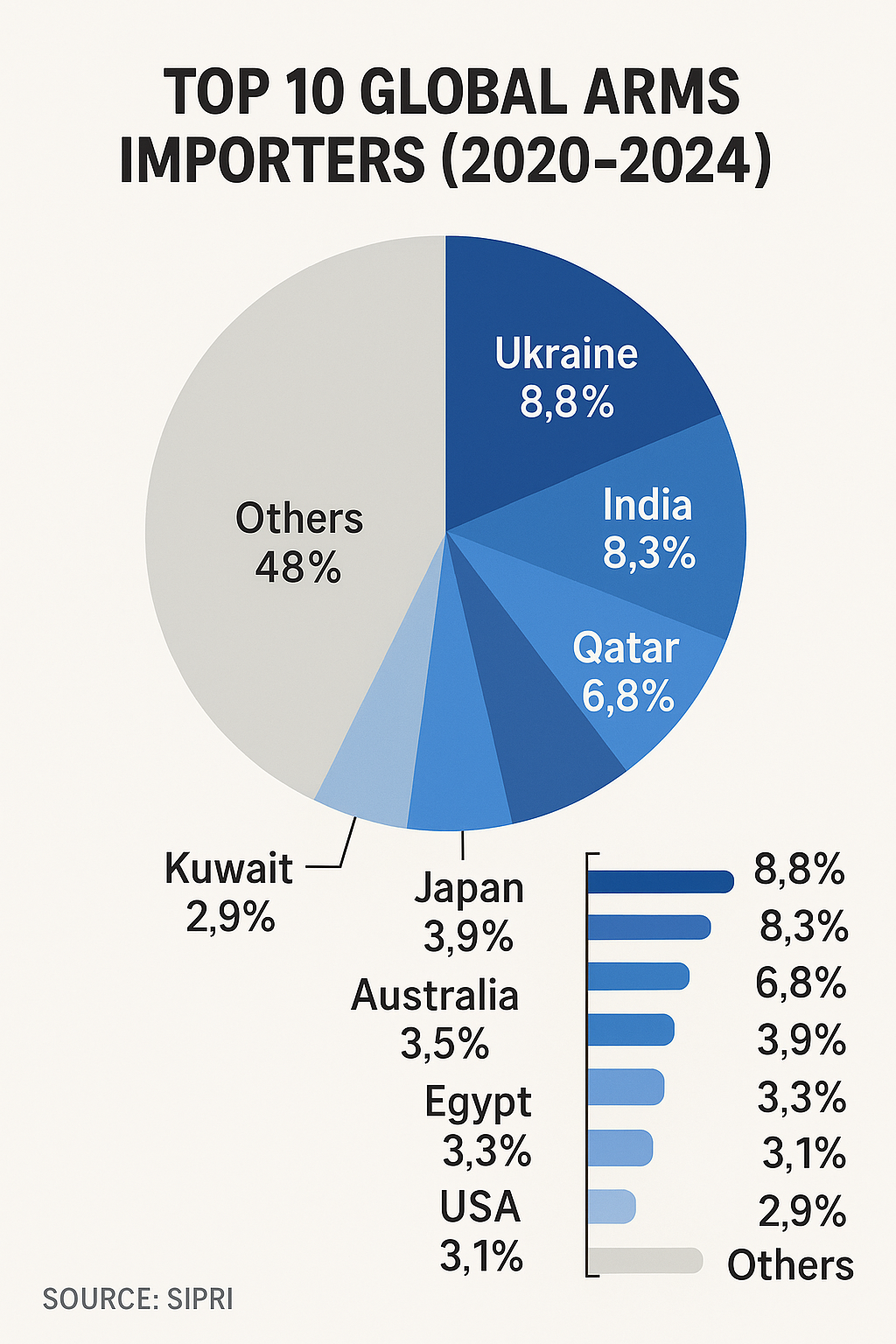
The global arms trade is a complex web of geopolitical interests, regional conflicts, and national security imperatives. Recent data from the Stockholm International Peace Research Institute (SIPRI) for the period 2020-2024 sheds critical light on the world’s leading arms importers, revealing significant shifts and persistent trends. Understanding these patterns is crucial for grasping the evolving landscape of international relations and security.
Key Insights from the SIPRI Report:
The SIPRI report highlights that while the overall volume of international arms transfers saw a slight decline of 0.6% between 2015-2019 and 2020-2024, significant regional re-configurations and substantial increases in certain areas, particularly Europe, shaped the global picture. The top 10 global arms importers for 2020-2024 are:
- Ukraine: 8.8%
- India: 8.3%
- Qatar: 6.8%
- Saudi Arabia: 6.8%
- Pakistan: 4.6%
- Japan: 3.9%
- Australia: 3.5%
- Egypt: 3.3%
- USA: 3.1%
- Kuwait: 2.9%
Top 10 global arms importers (2020-2024):
🇺🇦 Ukraine: 8.8%
🇮🇳 India: 8.3%
🇶🇦 Qatar: 6.8%
🇸🇦 Saudi Arabia: 6.8%
🇵🇰 Pakistan: 4.6%
🇯🇵 Japan: 3.9%
🇦🇺 Australia: 3.5%
🇪🇬 Egypt: 3.3%
🇺🇸 USA: 3.1%
🇰🇼 Kuwait: 2.9%Others: 48%
Source: SIPRI
— World of Statistics (@stats_feed) June 27, 2025
These ten nations collectively account for a substantial portion of global arms imports, with the “Others” category making up the remaining 48%. Let’s delve into the factors driving the significant procurements by these countries.
Ukraine: A Wartime Surge in Imports
Unsurprisingly, Ukraine has emerged as the world’s largest arms importer, accounting for 8.8% of global imports. This dramatic rise, a nearly 100-fold increase compared to the previous five-year period (2015-2019), is directly attributable to the full-scale Russian invasion in February 2022. The overwhelming majority of these arms have been supplied as military aid from at least 35 countries, with the United States being the primary contributor (45%), followed by Germany (12%) and Poland (11%). This influx of weaponry reflects the urgent need for defense capabilities in the face of ongoing conflict.
India: Diversifying and Indigenizing
India ranks as the second-largest arms importer at 8.3%. While still a major buyer, its imports declined by 9.3% compared to the 2015-2019 period. This reduction is a testament to India’s growing focus on domestic defense manufacturing and its “Make in India” initiative, aiming for greater self-reliance. Historically, Russia has been India’s largest supplier, but there’s a clear trend of diversification towards Western partners like France (28% of India’s imports) and Israel (34%), and even increasing engagement with the United States. This strategic shift is driven by a desire to reduce dependency and acquire cutting-edge technologies from a wider array of sources.
Middle East: Regional Tensions Fueling Acquisitions
The Middle East remains a significant region for arms imports, with Qatar (6.8%), Saudi Arabia (6.8%), Egypt (3.3%), and Kuwait (2.9%) featuring in the top 10. While overall Middle Eastern imports saw a 20% decrease between 2015-2019 and 2020-2024, the region continues to be a major market for advanced military hardware.
- Qatar’s arms imports surged by 127% compared to the previous period, making it the top importer in the Middle East for the first time. This substantial rearmament is primarily driven by perceived regional insecurity and past tensions with its neighbors. The USA (48%), Italy (20%), and the UK (15%) are its main suppliers.
- Saudi Arabia, despite a 41% decrease in imports from its previous top position, remains a major player. Its acquisitions are largely cyclical, but ongoing regional dynamics and modernization plans ensure continued demand. The USA (74%) remains its dominant supplier.
- Egypt and Kuwait continue to invest in modernizing their defense capabilities, driven by regional security concerns and the need to maintain stability. The USA is a key supplier for both, alongside European nations like Italy and France.
Pakistan: A Persistent Reliance on Key Allies
Pakistan, at 4.6%, holds the fifth spot among global arms importers. Its procurement patterns are heavily influenced by its regional security dynamics, particularly with India. China has emerged as Pakistan’s overwhelmingly dominant arms supplier, accounting for 81% of its major arms imports in 2020-2024, up from 74% in the previous period. This reliance underscores a strategic partnership and a consistent effort to modernize its armed forces.
East Asia and Oceania: Addressing Evolving Security Landscapes
Japan (3.9%) and Australia (3.5%) represent the significant arms imports in the Asia and Oceania region.
- Japan’s increased imports, a 93% rise from 2015-2019, reflect its evolving security posture and growing concerns over regional tensions, particularly with China and North Korea. The USA supplies 97% of Japan’s arms, including advanced systems like F-35 fighter jets and missile defense.
- Australia’s imports, while slightly down from previous periods, continue to focus on advanced defense systems, largely driven by perceived heightened threats from China. The USA (81%) is its primary supplier.
United States: The Dual Role of Importer and Exporter
Interestingly, the USA appears on the list as the ninth-largest arms importer at 3.1%. While primarily the world’s leading arms exporter, its imports often consist of specialized components, unique technologies, or systems from close allies that complement its vast domestic production capabilities. This highlights the interconnectedness of global defense industries.
The SIPRI data for 2020-2024 paints a vivid picture of a global arms market shaped by ongoing conflicts, regional power dynamics, and national security objectives. Ukraine’s dramatic rise underscores the immediate impact of war, while India’s efforts towards indigenization highlight a longer-term strategic shift. The consistent demand from the Middle East and the growing imports in East Asia reflect persistent geopolitical tensions. As nations navigate complex security environments, the flow of arms will continue to be a critical indicator of global stability and evolving international relations.