Vishal
The Middle East is witnessing a dangerous escalation in the conflict between Israel and Iran, now in its second week. The hostilities have intensified with direct military engagements, including Israel’s “Operation Rising Lion”—a series of extensive airstrikes targeting Iranian nuclear and military facilities—followed by retaliatory missile and drone attacks from Iran.
At the heart of this crisis lies Iran’s Fordow nuclear enrichment facility, a deeply buried and heavily fortified site that has proven resistant to even the most advanced conventional “bunker buster” bombs. The perceived inadequacy of conventional weapons has led to alarming discussions about the potential use of tactical nuclear weapons by the United States—a scenario that Russia has warned would be “catastrophic.”
This article provides an in-depth analysis of:
-
The strategic significance of Fordow and its role in Iran’s nuclear program.
-
The limitations of conventional strikes and why nuclear options are being considered.
-
Escalation risks, including the humanitarian and economic fallout.
-
International reactions and diplomatic efforts to de-escalate the crisis.
-
Future scenarios, from diplomatic resolutions to full-scale regional war.
Iran’s Nuclear Program: Historical Context and Current Status
Iran’s pursuit of nuclear technology traces its origins to the 1950s, when the country first established its atomic energy program under the U.S.-backed “Atoms for Peace” initiative. During this period, Iran was ruled by the Western-aligned Shah, Mohammad Reza Pahlavi, who sought to modernize the nation’s infrastructure, including its energy sector. The U.S. and other Western powers provided technical assistance, research reactors, and nuclear fuel under the premise of peaceful energy development.
However, the 1979 Islamic Revolution dramatically altered Iran’s geopolitical trajectory. The new theocratic regime, led by Ayatollah Ruhollah Khomeini, initially suspended the nuclear program, viewing it as a symbol of Western influence. Yet, by the late 1980s, following the devastating Iran-Iraq War—during which Saddam Hussein’s Iraq used chemical weapons against Iranian forces—Tehran quietly revived its nuclear ambitions, this time with a stronger emphasis on self-sufficiency and military deterrence.
Revelation of Secret Nuclear Facilities (2000s)
The early 2000s marked a turning point when opposition groups and Western intelligence agencies exposed Iran’s clandestine nuclear activities. Two key sites came under international scrutiny:
🛩️ IAF fighter jets struck the Iranian Regime’s Internal Security HQ and the HQ of the regime’s special internal security units in Tehran earlier this week.
Take a look at what type of infrastructure was located in these places: pic.twitter.com/HoPWCtaivi
— Israel Defense Forces (@IDF) June 20, 2025
-
Natanz Uranium Enrichment Facility – A sprawling underground complex housing thousands of centrifuges for uranium enrichment.
-
Arak Heavy Water Reactor – Designed to produce plutonium, an alternative pathway to nuclear weapons.
These revelations led to widespread condemnation, UN sanctions, and diplomatic pressure aimed at curbing Iran’s nuclear ambitions. Despite being a signatory to the Treaty on the Non-Proliferation of Nuclear Weapons (NPT), Iran’s repeated violations—including secret uranium enrichment and restricted access for IAEA inspectors—raised alarms about its true intentions.
The JCPOA and Its Collapse (2015-2018)
In 2015, after years of tense negotiations, Iran and the P5+1 (U.S., UK, France, China, Russia, and Germany) reached the Joint Comprehensive Plan of Action (JCPOA). Under this deal:
-
Iran agreed to limit uranium enrichment to 3.67% purity (far below weapons-grade).
-
It dismantled two-thirds of its centrifuges and allowed intrusive IAEA inspections.
-
In return, economic sanctions were lifted, providing Tehran with financial relief.
However, in 2018, the Trump administration unilaterally withdrew from the JCPOA, reimposing crippling sanctions. Iran responded by gradually abandoning its commitments, increasing uranium enrichment to 60% purity (just a short technical step from the 90% required for nuclear weapons), and expanding its stockpile of advanced centrifuges.
Today, Iran stands closer than ever to nuclear breakout capability, with Fordow serving as the linchpin of its hardened nuclear infrastructure.
Fordow’s Strategic Importance: An Impregnable Nuclear Fortress
Location and Structural Hardening
The Fordow Fuel Enrichment Plant (FFEP), located deep within the Zagros Mountains near Qom, is Iran’s most heavily fortified nuclear facility. Unlike Natanz, which is partially above ground, Fordow is buried 80-90 meters (260-295 feet) beneath a mountain, encased in layers of reinforced concrete, shock-absorbing materials, and natural rock formations.
Key defensive features include:
-
Multiple underground tunnel networks designed to withstand seismic shocks and aerial bombardment.
-
Advanced Russian-made S-300 and indigenous Bavar-373 air defense systems to intercept incoming missiles.
-
Redundant centrifuge halls—if one section is destroyed, enrichment can continue in another.
Operational Status and Breakout Potential
Despite repeated Israeli airstrikes on other nuclear sites, the IAEA confirms Fordow remains fully operational, enriching uranium to 60% purity. This near-weapons-grade enrichment, combined with Fordow’s invulnerability to conventional strikes, makes it Iran’s “breakout option”—ensuring that even if other facilities are destroyed, Tehran retains the capacity to rapidly produce fissile material for a bomb.
Why Fordow is a Game-Changer in Nuclear Proliferation
Fordow’s design represents a strategic masterstroke by Iran:
-
Deterrence Against Military Strikes – Its depth and hardening make it nearly impossible to destroy without resorting to extreme measures.
-
Insurance for Nuclear Ambitions – Even if Natanz is disabled, Fordow ensures continuity of enrichment.
-
Psychological Pressure on Adversaries – The facility’s resilience forces Israel and the U.S. to consider riskier military options, including nuclear bunker busters.
Why Conventional “Bunker Busters” Fail Against Fordow
The GBU-57 Massive Ordnance Penetrator (MOP): Limits of Conventional Strikes
The U.S. military’s most powerful conventional bunker-buster, the GBU-57 MOP, is a 30,000-pound precision-guided bomb designed to penetrate up to 60 meters (200 feet) of reinforced concrete. However, against Fordow, it faces insurmountable challenges:
1. Depth and Geological Barriers
-
Fordow is buried deeper (80-90m) than the MOP’s maximum penetration.
-
The mountain’s dense rock layers can deflect or prematurely detonate the bomb.
-
Multiple internal blast doors further mitigate damage.
2. Delivery Constraints
-
Only the B-2 Spirit stealth bomber can carry the MOP, limiting strike options.
-
Iran’s integrated air defenses make penetration difficult even for stealth aircraft.
3. Limited Strategic Impact
Even if a direct hit collapses some tunnels, Fordow’s redundant infrastructure means:
-
Centrifuges in other sections remain operational.
-
Iran could rebuild within 2-3 years, rendering the strike a temporary setback.
The Deadlock: When Conventional Weapons Aren’t Enough
This military impasse has led to a dangerous escalation dynamic:
-
Israel and the U.S. cannot eliminate Fordow with conventional means.
-
Diplomatic solutions are stalled due to Iran’s refusal to halt enrichment.
-
Nuclear bunker busters (like the B61-11) are now being openly discussed as a last resort.
The Nuclear Option: A Catastrophic Possibility
The B61-11 earth-penetrating nuclear warhead (yield: 0.3-340 kilotons) is the only weapon theoretically capable of fully destroying Fordow. However, its use would:
-
Release massive radioactive fallout, contaminating water and soil across Iran.
-
Trigger a global outcry and potential nuclear escalation (Russia has already warned of “catastrophic consequences”).
-
Set a perilous precedent for nuclear use in non-nuclear states.
II. The Tactical Nuclear Option: Risks and Consequences
Reports of U.S. Deliberation
Recent media reports suggest the U.S. military has considered a nuclear strike on Fordow, using a B61-11 earth-penetrating warhead (yield: 0.3-340 kilotons).
-
The Guardian reported that while President Trump was briefed, no formal decision was made.
-
The White House maintains “all options are on the table,” including nuclear use.
Russia’s Dire Warning
The Kremlin has strongly condemned any potential nuclear strike, warning it would trigger a “terrible spiral of escalation.”
Catastrophic Fallout Risks
Even a “low-yield” nuclear strike on Fordow could:
-
Release radioactive debris into the atmosphere.
-
Contaminate groundwater and soil across Iran and neighboring countries.
-
Kill thousands and cause long-term health crises.
IAEA Director Rafael Grossi has warned that attacks on nuclear sites risk radiological disasters, particularly at Bushehr Nuclear Power Plant, where a direct hit could cause a Fukushima-level meltdown.
III. The Israel-Iron Conflict: Escalation and Humanitarian Toll
“Operation Rising Lion”: Israel’s Pre-emptive Strikes
On June 13, 2025, Israel launched massive airstrikes targeting:
-
Natanz uranium enrichment facility (partially destroyed).
-
Arak heavy-water reactor (inactive, minimal damage).
-
SPND (Iran’s nuclear research HQ).
-
Missile production sites.
Israel’s goal: “Degrade, destroy, and remove” Iran’s nuclear capabilities.
Iran’s Retaliation: Missile and Drone Barrages
Iran has fired over 450 ballistic missiles and hundreds of drones, hitting:
-
Tel Aviv, Haifa, Beersheba.
-
Soroka Medical Center (Beersheba hospital strike).
-
Civilian areas with cluster munitions (Khorramshar-4 missiles).
Humanitarian Crisis
-
Iran: 657+ killed (263 civilians), 2,000+ wounded.
-
Israel: 24 killed, hundreds wounded.
-
Internet blackouts in Iran hinder information flow.
IV. International Reactions and Diplomatic Efforts
Russia’s Stance
-
Strongly opposes U.S. intervention.
-
Warns of “catastrophic escalation” if nukes are used.
Russia, maintaining close ties with Iran, has issued strong and unequivocal warnings against any potential US military intervention in the conflict.
Kremlin spokesman Dmitry Peskov explicitly stated that any use of nuclear weapons by the US in Iran would be a “catastrophic development” and would initiate a “terrible spiral of escalation.”
These comments were made in response to speculative media reports about such a possibility.
Beyond warnings, Russia has historically offered to play a role in dismantling Iran’s nuclear program, suggesting a potential, albeit complex, diplomatic pathway.
European Mediation
-
EU-led talks in Geneva seek de-escalation.
-
Iran demands “zero uranium enrichment” halt—a non-starter for Israel/U.S.
European officials are actively engaged in diplomatic interventions, seeking to de-escalate the conflict and bring Tehran back to the negotiating table.
Iranian Foreign Minister Abbas Araghchi traveled to Geneva for a meeting with his French, German, British, and European Union counterparts, marking the first face-to-face talks in the crisis.
British Foreign Secretary David Lammy underscored the urgency of the situation, emphasizing that the coming two weeks represent a critical “window… to achieve a diplomatic solution”.
Despite expressing interest in negotiations, Iran has not softened its pre-conflict negotiating positions, particularly rejecting the US demand for “zero uranium enrichment”.
Iranian Foreign Minister Araghchi’s explicit statements that Israel’s attack was a “betrayal of diplomacy” and occurred “in the midst of an ongoing diplomatic process” are significant.
This narrative, if solidified and widely propagated by Iran and its allies, could severely undermine the credibility and viability of any future diplomatic efforts.
It frames Israel as actively sabotaging peace, making it exceedingly difficult for Iran to return to the negotiating table without appearing to lose face or concede under duress.
The direct cancellation of the US-Iran meeting immediately after the Israeli attack serves as a tangible reinforcement of this perception of diplomatic betrayal.
The timing of Israel’s “Operation Rising Lion” during ongoing diplomatic overtures creates a significant and potentially long-lasting trust deficit.
This could harden Iran’s negotiating stance, making a return to a comprehensive nuclear deal far more difficult and increasing the likelihood that military options are seen as the only viable path forward, leading to a prolonged diplomatic impasse.
U.S. Strategic Ambiguity
-
Trump: “No options off the table.”
-
Demands Iran’s “unconditional surrender.”
President Donald Trump has indicated that a decision regarding potential American involvement in the Israel-Iran conflict would be made within two weeks, maintaining an element of strategic ambiguity.
Trump initially distanced himself from Israel’s surprise attack but has since hinted at greater American involvement, expressing a desire for something “much bigger” than a ceasefire and publicly calling for Iran’s “UNCONDITIONAL SURRENDER“.
The US has consistently reiterated its firm stance that Iran “cannot have a nuclear weapon,” a core policy objective. A planned meeting between US Special Envoy Steve Witkoff and Iranian Foreign Minister Araghchi in Oman on June 15 was abruptly canceled following the Israeli attack, highlighting the immediate negative impact of military action on diplomatic channels.
Iranian Foreign Minister Araghchi publicly condemned Israel’s attack as a “betrayal of diplomacy” and an “unprecedented blow to the foundations of international law,” noting that it occurred “in the midst of an ongoing diplomatic process”.
President Trump’s statements create a deliberate “strategic ambiguity,” oscillating between maintaining “all options” and demanding “unconditional surrender” , while simultaneously setting a two-week decision window.
While often employed to keep adversaries off balance, in a highly volatile nuclear context, this ambiguity can be profoundly destabilizing.
It might provide some deterrence against Iran, but it also risks being misinterpreted by allies (like Israel) as tacit approval or encouragement for extreme actions, or by adversaries (Russia, Iran) as a clear signal of aggressive intent.
This is footage from the moment an Iranian ballistic missile hit a children’s center in southern Israel.
When the world asks why we’re fighting Iran, this is your answer: pic.twitter.com/UcdeYwsKjA
— Israel Defense Forces (@IDF) June 20, 2025
Such misinterpretations significantly increase the risk of miscalculation and unintended escalation.
The US’s deliberately ambiguous posture, while intended to maintain leverage, risks exacerbating the current crisis by increasing uncertainty among all parties.
This lack of clear red lines or intentions could lead to misinterpretations of strategic signals, potentially triggering actions that neither the US nor its allies fully intend, thereby pushing the conflict into an uncontrollable and devastating spiral.
V. Geopolitical and Economic Fallout
Regional Instability Risks
The current conflict has “catapulted their long-running conflict into what could become a wider, more dangerous regional war,” signaling a significant shift in regional dynamics.
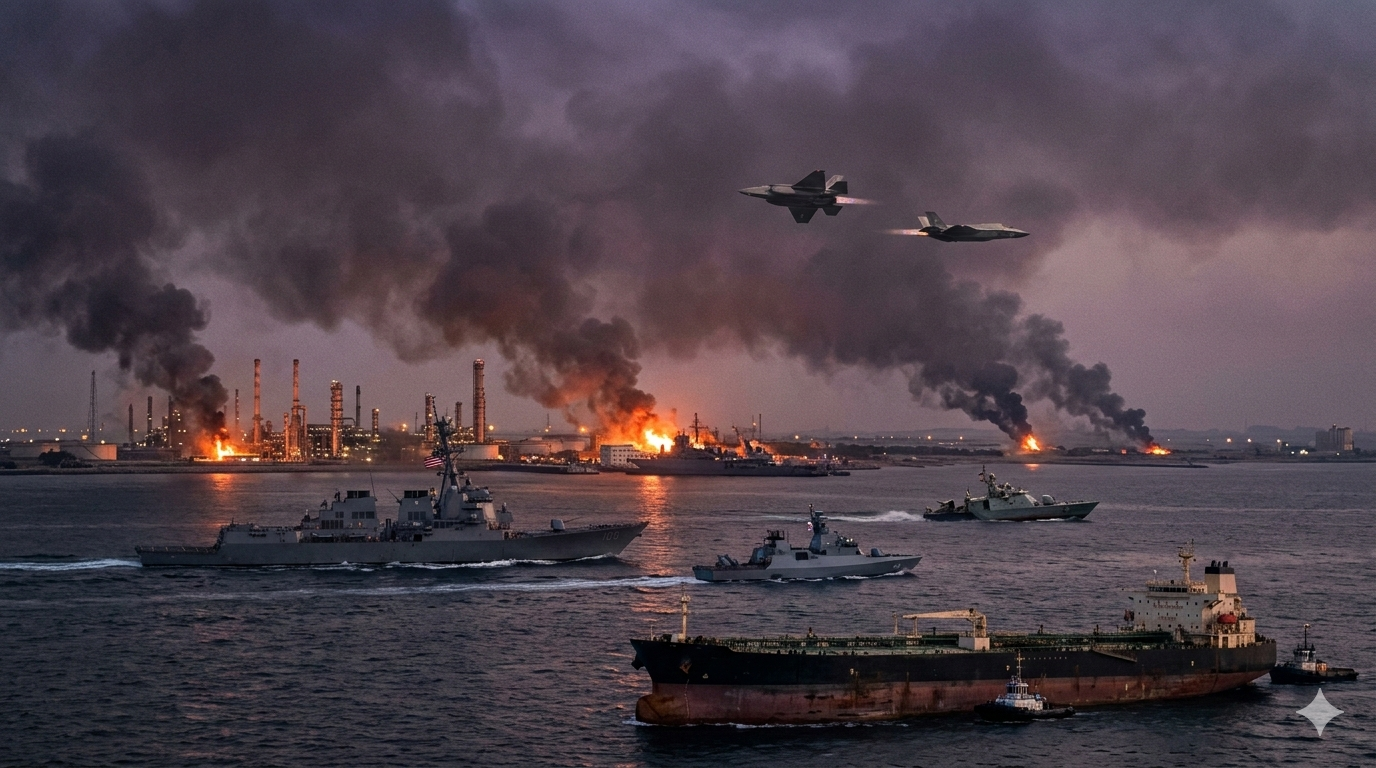
Iranian-backed Iraqi militias have issued explicit threats of retaliation against US bases in the region, and warned of the closure of critical maritime chokepoints such as the Strait of Hormuz and Bab al Mandab, along with Red Sea ports, should the US directly intervene in the war.
In response to these threats, the US has already repositioned military aircraft and naval vessels from its bases in Qatar and Bahrain, describing this as a “standard force protection measure” to mitigate potential Iranian attacks.
Turkish President Recep Tayyip Erdogan has warned that the ongoing war between Iran and Israel could lead to an increase in migration to Europe and poses a broader risk of “nuclear leakage,” highlighting the cross-border and international implications.
-
Iraqi militias threaten U.S. bases.
-
Strait of Hormuz closures could spike oil prices.
The explicit threats by Iranian-backed Iraqi militias to target US bases and critical maritime chokepoints like the Strait of Hormuz are not isolated incidents but rather a clear indication that the conflict is not confined to Israel and Iran.
These threats represent the activation of a wider “Axis of Resistance” strategy. If the US directly intervenes, these proxies are poised to become active participants, transforming a bilateral conflict into a multi-front regional war.
This significantly expands the geographical scope of the conflict and increases the number of active belligerents, making de-escalation exponentially more complex and difficult to achieve.
The conflict’s escalation pathways are deeply intertwined with established regional proxy networks.
Direct US military involvement risks activating these proxies, which would transform the Israel-Iran conflict into a broader regional conflagration with unpredictable and severe consequences for global energy security, international shipping, and overall regional stability.
Global Economic Shock
The conflict introduces an additional layer of geopolitical uncertainty to an already strained global economic outlook. Immediately following Israel’s initial attack, global oil and gold prices surged, with Brent crude prices rising by approximately 10% and natural gas prices increasing by about 7% since June 13.
A wider war could severely disrupt or halt the flow of oil from Iran, a major global producer, significantly impacting global supply and demand dynamics.
The Strait of Hormuz, one of the world’s most critical oil transit chokepoints, is directly affected, with International Monetary Fund (IMF) data already indicating a notable decline in cargo and tanker ships passing through.
-
Oil prices up 10% since June 13.
-
Shipping costs surge as vessels reroute.
-
Central banks may delay rate cuts, worsening inflation.
Higher energy prices, combined with increased production and transportation costs, can lead to elevated costs for a wide range of products, potentially fueling broader inflationary pressures globally.
Central banks may be compelled to delay anticipated interest rate cuts or even raise rates, which would increase borrowing costs for businesses and consumers, potentially stifling economic activity.
Shipping costs and insurance premiums are already rising due to vessel rerouting away from the Middle East, which will squeeze profit margins for businesses and ultimately contribute to higher consumer prices.
While the most immediate and visible economic impact is on oil and gas prices , the situation reveals a more insidious and widespread inflationary risk.
Increased shipping costs due to necessary rerouting of vessels and higher insurance premiums will affect the cost of all internationally traded goods, not just energy.
This widespread increase in logistical costs, combined with the tendency of firms to pass on additional costs to consumers and the potential for central banks to raise interest rates in response , suggests a multi-faceted inflationary pressure.
This could impact global economic stability far beyond the direct conflict zone, potentially leading to a broader economic downturn.
The conflict threatens to trigger a new, broader wave of global inflation that extends beyond energy prices to encompass widespread supply chain disruptions and increased operational costs across various sectors.
This scenario would force central banks into difficult policy choices, potentially leading to economic slowdowns or even recessions in major global economies, demonstrating the far-reaching and complex economic contagion of regional conflicts.
VI. Future Scenarios
-
Diplomatic Breakthrough (Unlikely): EU-mediated talks stall due to Iran’s hardline stance.
-
Continued Limited War: Tit-for-tat strikes with no nuclear escalation.
-
Regional War: U.S. intervention triggers proxy attacks across the Middle East.
-
Nuclear Escalation (Worst-Case): A B61-11 strike on Fordow risks global radiation fallout.
Discussion of Potential Scenarios
The current situation presents several precarious pathways:
- De-escalation through Diplomacy: A narrow and precarious window for diplomacy still exists, with European nations actively pursuing efforts to bring Iran back to negotiations. However, Iran’s unyielding stance on uranium enrichment and its perception of Israel’s actions as a “betrayal of diplomacy” pose formidable obstacles to any meaningful breakthrough.
- Continued Limited Escalation: The conflict could persist in a pattern of tit-for-tat strikes, gradually increasing in intensity and the scope of targets, but without direct US military intervention or the deployment of nuclear weapons. This scenario, while avoiding the most catastrophic outcomes, would still incur heavy human and economic costs for both sides and the region.
- Major Regional War: Direct US military involvement, particularly a decisive strike on Fordow, could trigger a cascade of Iranian proxy attacks across the region. This would likely lead to a multi-front conflict involving US forces, severely threaten critical global shipping lanes, and potentially draw in other regional powers, creating widespread instability.
- Nuclear Escalation: The most catastrophic scenario involves the failure of conventional military means against Fordow leading to the deployment of a nuclear earth penetrator. This would risk widespread radiological contamination, potentially triggering an uncontrollable strategic nuclear exchange with devastating global consequences.