 Vishal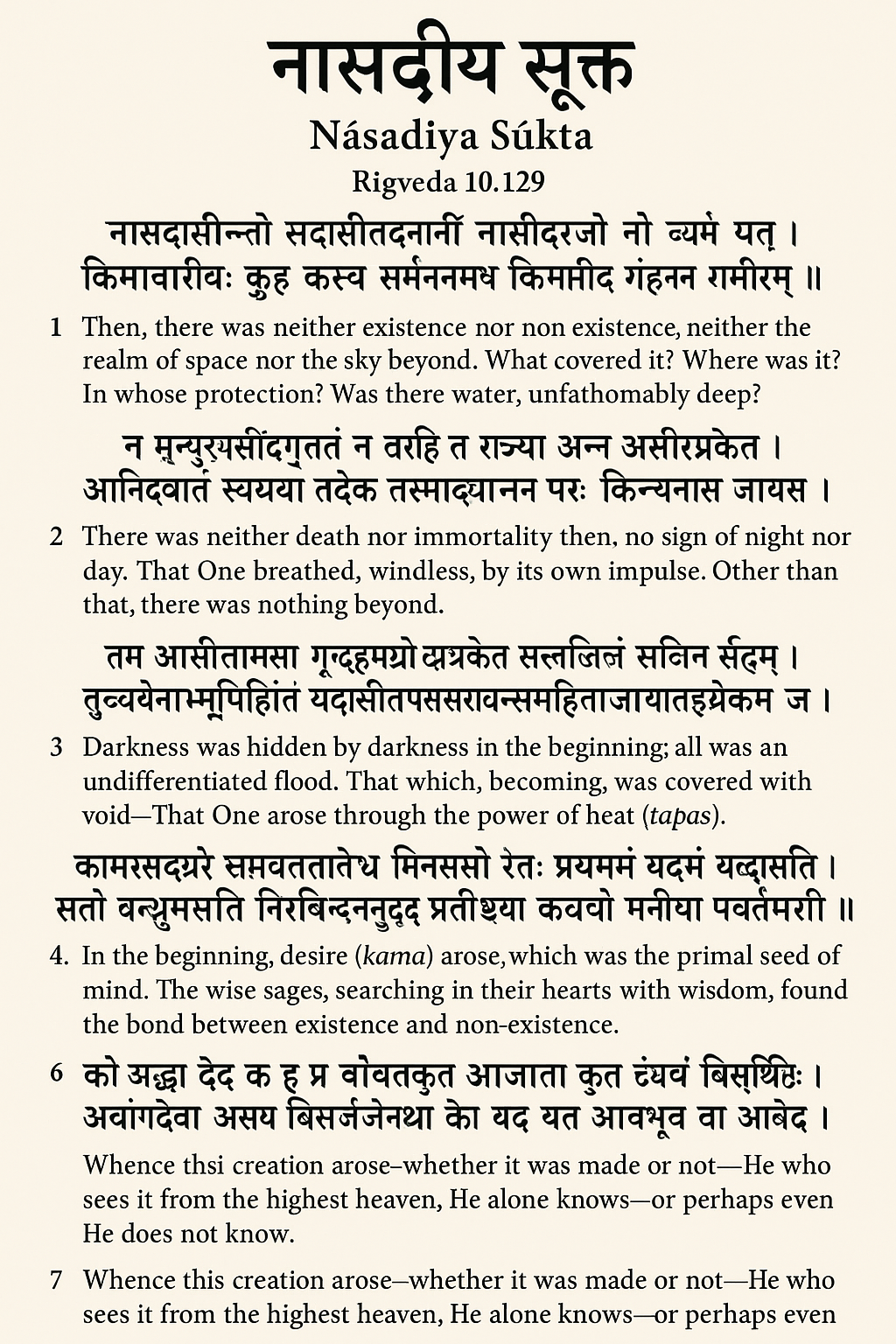
The Nasadiya Sukta (Sanskrit: नासदीय सूक्त), also known as the Hymn of Creation, is the 129th hymn of the 10th Mandala (book) of the Rig Veda, one of the oldest sacred texts of Hinduism.
This profound hymn contemplates the origins of the universe, questioning the very nature of existence and non-existence.
Unlike many other creation myths that provide definitive answers, the Nasadiya Sukta adopts a philosophical, skeptical, and open-ended approach, making it one of the most intriguing and widely discussed passages in Vedic literature.
Structure and Content of the Nasadiya Sukta
The hymn consists of seven verses (ṛcās) composed in the trishtubh meter, a common Vedic poetic form.
Each verse progressively explores the mystery of creation, moving from a state of primordial void to the emergence of cosmic order, yet concluding with profound uncertainty.
Key Themes and Interpretations
-
The Primordial State: Beyond Existence and Non-Existence
The hymn begins with a paradoxical statement:“Then, there was neither existence nor non-existence; neither the realm of space nor the sky beyond.” (Rig Veda 10.129.1)
This suggests a state of absolute potentiality, where neither being nor nothingness prevailed—a concept that aligns with modern cosmological theories about the quantum vacuum before the Big Bang.
-
The Emergence of the “One” (Tad Ekam)
Verse 2 introduces “That One” (Tad Ekam), a self-sustaining, breathless force that existed before all else:“That One breathed, windless, by its own impulse; other than that, there was nothing beyond.”
This hints at an impersonal, self-contained cosmic principle, possibly an early precursor to later Hindu concepts like Brahman (the ultimate reality).
-
The Role of Desire (Kāma) and Cosmic Heat (Tapas)
Verse 4 introduces desire (kāma) as the primal seed of creation:“Desire descended upon it in the beginning, that which was the first seed of mind.”
This aligns with later Vedic and Puranic cosmogonies where cosmic desire drives creation. Additionally, tapas (austerity/heat) is mentioned as a creative force, resembling the intense energy of the early universe.
-
The Uncertainty of Creation
The hymn concludes with a striking admission of ignorance:“Who truly knows? Who can declare it? Whence was it born, whence came this creation? The gods came later, with the creation of this universe. Who then knows whence it arose?” (Rig Veda 10.129.6-7)
This agnostic tone is rare in religious texts, suggesting that even the gods may not know the ultimate origin.
नासदीय सूक्तम् (Nasadiya Suktam) – Rigveda 10.129
Verse 1
नासदासीन्नो सदासीत्तदानीं नासीद्रजो नो व्योमा परो यत् ।
किमावरीवः कुह कस्य शर्मन्नम्भः किमासीद्गहनं गभीरम् ॥ १॥
Transliteration:
nāsad āsīn no sad āsīt tadānīṁ nāsīd rajo no vyomā paro yat |
kim āvarīvaḥ kuha kasya śarmann ambhaḥ kim āsīd gahanaṁ gabhīram || 1 ||
Translation:
“Then, there was neither existence nor non-existence; neither the realm of space nor the sky beyond. What covered it? Where was it? In whose protection? Was there water, unfathomably deep?”
Verse 2
न मृत्युरासीदमृतं न तर्हि न रात्र्या अह्न आसीत्प्रकेतः ।
आनीदवातं स्वधया तदेकं तस्माद्धान्यन्न परः किञ्चनास ॥ २॥
Transliteration:
na mṛtyur āsīd amṛtaṁ na tarhi na rātryā ahna āsīt praketaḥ |
ānīd avātaṁ svadhayā tad ekaṁ tasmād dhānyan na paraḥ kiñcanāsa || 2 ||
Translation:
“There was neither death nor immortality then; no sign of night nor day. That One breathed, windless, by its own impulse. Other than that, there was nothing beyond.”
Verse 3
तम आसीत्तमसा गूळ्हमग्रेऽप्रकेतं सलिलं सर्वमाऽइदम् ।
तुच्छ्येनाभ्वपिहितं यदासीत्तपसस्तन्महिनाजायतैकम् ॥ ३॥
Transliteration:
tama āsīt tamasā gūḻham agre ‘praketaṁ salilaṁ sarvam ā idam |
tucchyenābhv apihitaṁ yad āsīt tapasas tan mahinā jāyataikam || 3 ||
Translation:
“Darkness was hidden by darkness in the beginning; all was an undifferentiated flood. That which, becoming, was covered with void—That One arose through the power of heat (tapas).”
Verse 4
कामस्तदग्रे समवर्तताधि मनसो रेतः प्रथमं यदासीत् ।
सतो बन्धुमसति निरविन्दन्हृदि प्रतीष्या कवयो मनीषा ॥ ४॥
Transliteration:
kāmas tad agre sam avartatādhi manaso retaḥ prathamaṁ yad āsīt |
sato bandhum asati nir avindan hṛdi pratīṣyā kavayo manīṣā || 4 ||
Translation:
“In the beginning, desire (kāma) arose, which was the primal seed of mind. The wise sages, searching in their hearts with wisdom, found the bond between existence and non-existence.”
Verse 5
तिरश्चीनो विततो रश्मिरेषामधः स्विदासीदुपरि स्विदासीत् ।
रेतोधा आसन्महिमान आसन्त्स्वधा अवस्तात्प्रयतिः परस्तात् ॥ ५॥
Transliteration:
tiraścīno vitato raśmir eṣām adhaḥ svid āsīd upari svid āsīt |
retodhā āsan mahimāna āsantsvadhā avastāt prayatiḥ parastāt || 5 ||
Translation:
“Their cord (of inquiry) was extended across. Was there something below? Was there something above? There were seed-bearers, there were powers. There was energy beneath, and impulse above.”
Verse 6
को अद्धा वेद क इह प्र वोचत्कुत आजाता कुत इयं विसृष्टिः ।
अर्वाग्देवा अस्य विसर्जनेनाथा को वेद यत आबभूव ॥ ६॥
Transliteration:
ko addhā veda ka iha pra vocat kuta ājātā kuta iyaṁ visṛṣṭiḥ |
arvāg devā asya visarjanenāthā ko veda yata ābabhūva || 6 ||
Translation:
“Who truly knows? Who can declare it? From where was it born? From where did this creation arise? The gods came later, with the creation of this universe. Who then knows from where it has arisen?”
Verse 7
इयं विसृष्टिर्यत आबभूव यदि वा दधे यदि वा न ।
यो अस्याध्यक्षः परमे व्योमन्त्सो अङ्ग वेद यदि वा न वेद ॥ ७॥
Transliteration:
iyaṁ visṛṣṭir yata ābabhūva yadi vā dadhe yadi vā na |
yo asyādhyakṣaḥ parame vyomantso aṅga veda yadi vā na veda || 7 ||
Translation:
“Whence this creation arose—whether it was made or not—He who sees it from the highest heaven, He alone knows—or perhaps even He does not know.”
Philosophical and Scientific Significance
1. Parallels with Modern Cosmology
The Nasadiya Sukta’s description of a formless, undifferentiated state before creation bears striking resemblance to modern scientific theories:
-
Big Bang Theory: The hymn’s depiction of a primordial void aligns with the concept of a singularity before the universe’s expansion.
-
Quantum Fluctuations: The idea of “neither existence nor non-existence” mirrors quantum physics’ uncertainty principle, where particles flicker in and out of existence.
Renowned astronomer Carl Sagan referenced this hymn in Cosmos, admiring its “skeptical questioning and humility before cosmic mysteries.”
2. Influence on Hindu Philosophy
The Nasadiya Sukta laid the groundwork for later Hindu philosophical schools:
-
Advaita Vedanta: The concept of Tad Ekam (That One) influenced Adi Shankara’s non-dualistic philosophy.
-
Sāṃkhya & Yoga: The mention of desire (kāma) and cosmic heat (tapas) aligns with Sāṃkhya’s theory of purusha (consciousness) and prakriti (matter).
3. Agnosticism and Open-Ended Inquiry
Unlike dogmatic creation myths, the hymn does not claim absolute knowledge. Instead, it encourages philosophical doubt, making it unique among ancient religious texts. This has led some scholars to view it as an early expression of scientific skepticism.
A Timeless Hymn of Cosmic Wonder
The Nasadiya Sukta stands as a monument to human curiosity, blending poetic mysticism, philosophical depth, and proto-scientific inquiry. Its refusal to provide dogmatic answers makes it strikingly modern, resonating with today’s cosmological and existential questions.
As we continue to explore the origins of the universe—through quantum physics, string theory, or multiverse hypotheses—the Nasadiya Sukta’s humility before the unknown remains a profound lesson: Some mysteries may forever transcend human understanding.
“Whence all creation had its origin,
He, the creator, may or may not know.
He who surveys it from the highest heaven,
Only He knows—or perhaps He does not.”
(Rig Veda 10.129.7)
Thus, the Nasadiya Sukta remains not just a relic of ancient thought, but a living dialogue between science, philosophy, and spirituality.
Read:- https://www.swami-krishnananda.org/vishnu/nasadiya.pdf







Hi,
I’m Kanak, a digital marketing expert with over a decade of experience in SEO, Google Ads, and conversion optimization.
I help businesses like yours boost their online visibility, rank higher in search results, and convert visitors into paying customers.
If you’re open to it, I’d love to take a quick look at your website and send you a custom growth.
Let me know your website URL and target audience.
Best regards,
Kanak