Vishal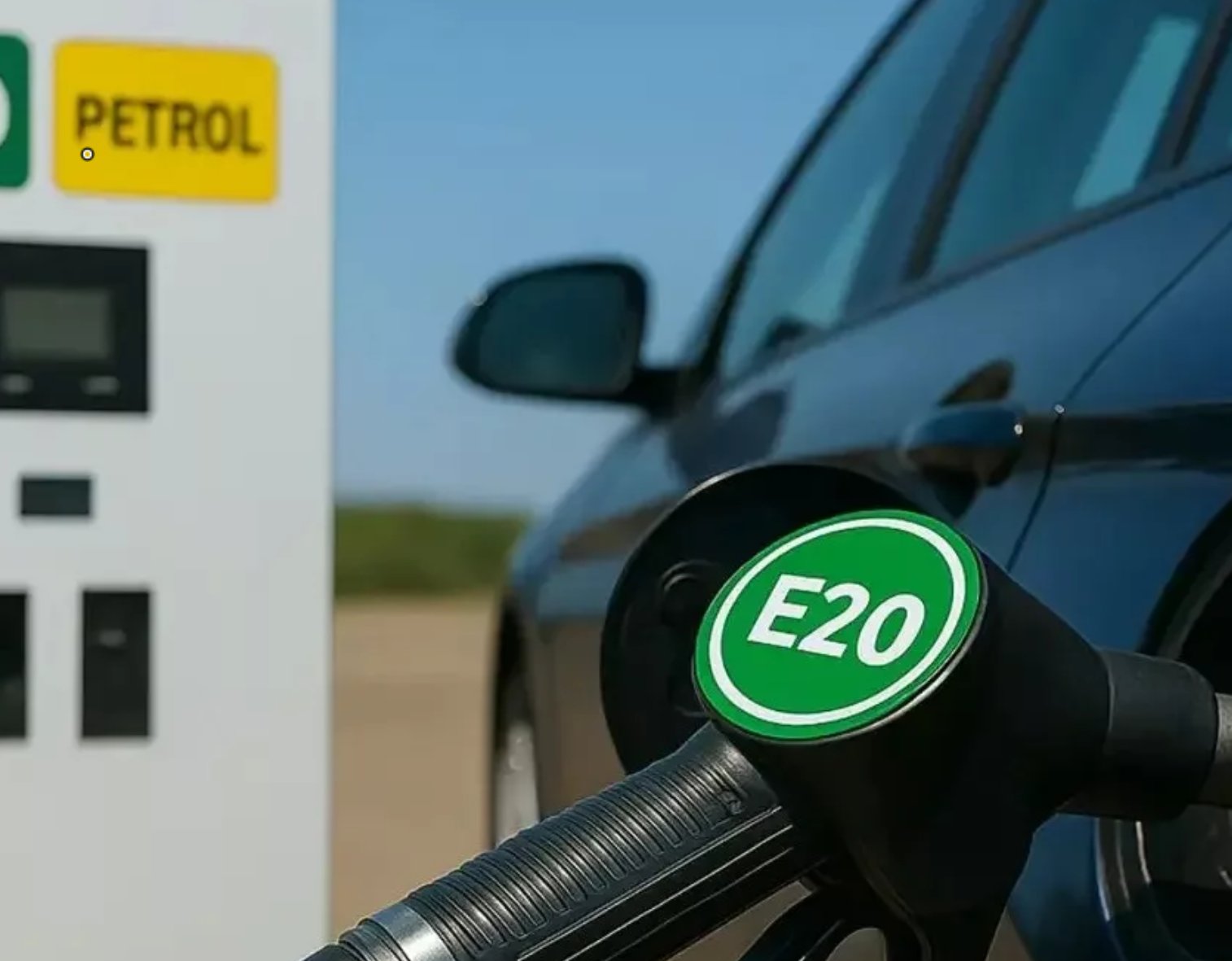
NEW DELHI – (E20) A quiet revolution is underway at India’s 90,000 petrol pumps, but for many motorists, the change is anything but peaceful.
The government’s nationwide rollout of E20 fuel, a blend of 20% ethanol with petrol, has become the new normal, replacing older fuels and leaving consumers with a single, high-stakes choice.
While policymakers and industry leaders hail the move as a strategic win for the economy and the environment, a growing chorus of vehicle owners is voicing concerns over performance, costs, and the future of their beloved rides.
The E20 Imperative: A Look at the Policy
The push for E20 is a cornerstone of Prime Minister Narendra Modi’s vision for a greener, more self-reliant India. Ethanol, an alcohol derived from sugarcane and grains, is seen as a crucial “bridge fuel” in the country’s journey towards energy independence.
The government’s messaging is clear: E20 will slash oil imports, saving billions in foreign exchange and boosting the income of farmers who supply the raw materials.
Beyond the economic benefits, E20 is also promoted as a cleaner-burning fuel that significantly reduces greenhouse gas emissions.
According to the Ministry of Petroleum and Natural Gas, the program has already saved over $17 billion in foreign exchange since 2014, with an expected additional saving of over $5 billion this year alone.
Read Also:-
Motorists’ Fears vs. Official Assurance
Despite the ambitious goals, the transition has been far from smooth. Unlike countries like Brazil and the United States, which offer a range of ethanol blends at the pump, India’s move has been a unilateral one. This has left millions of motorists, particularly those with older vehicles, feeling cornered.
The primary concerns circulating on social media and in online forums are two-fold: a drop in fuel efficiency and the potential for long-term engine damage.
Many older cars and bikes were designed to run on E10 or even pure petrol, and their manuals often state as much.
Anecdotal evidence from frustrated owners suggests a noticeable dip in mileage, in some cases as high as 15-20%.
In response, both the government and the auto industry have attempted to allay fears.
The Ministry of Petroleum and Natural Gas insists that a “drastic” reduction in mileage is a “misplaced” claim, citing studies that show a more marginal drop of 2-4%.
They contend that the loss of efficiency is outweighed by the national benefits and that any required part replacements in older vehicles are a “simple process” that can be handled during routine servicing.
The Society of Indian Automobile Manufacturers (SIAM) has also echoed the government’s line, reassuring consumers that warranties and insurance claims will be honoured.
A Shifting Stance and a Divided Public
This industry-wide support, however, marks a significant departure from a few years ago.
In 2020, SIAM had cautioned the government against a singular E20 mandate, arguing that it was a “mammoth task” to retrofit older vehicles and that E10 should remain an option for “safe operation.”
The change in tune has led to a sense of distrust among some consumers who feel the industry has sacrificed their interests for a top-down policy.
The public debate has been further complicated by the Supreme Court’s dismissal of a Public Interest Litigation (PIL) that sought to challenge the E20 mandate.
The court’s decision, which sided with the government’s argument of national interest, reinforces that the E20 program is here to stay.
Beyond the Headlines: The Long-Term Outlook
While the current angst is centred on mileage and vehicle compatibility, the E20 program’s long-term success hinges on broader economic and environmental factors.
The government points to the benefits for farmers, who are becoming “Urjadaatas” (energy providers) in addition to “Annadatas” (food providers). They also highlight the improved octane rating of E20, which they claim enhances performance in modern engines.
For now, the country is grappling with a classic policy dilemma: balancing the macro-level gains for the nation with the micro-level concerns of its citizens.
The E20 mandate is a bold leap towards a more sustainable and self-reliant future, but it has come at the cost of consumer choice and has placed the burden of adaptation squarely on the shoulders of the average Indian motorist.
The coming months will reveal if the promised benefits are enough to win over a sceptical public and if the auto industry’s assurances are sufficient to bridge the gap between policy and reality.
Read Also:-
Opinion | Supreme Court’s Stray Dog Order: Time to Put Human Safety First, Not Hypocrisy